Hello Lighting Tamers!
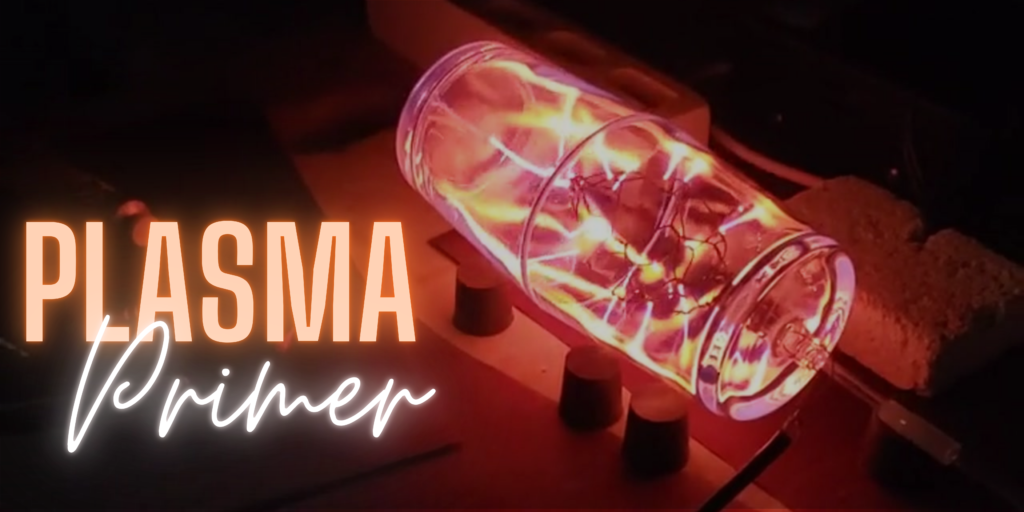
Iris van Herpen unveiled the Helix Nebula dress this week — a couture piece with living plasma suspended in two hand-blown glass forms, floating in tulle. The glass is Mundy Hepburn’s. If you’ve listened to this podcast, you know that name. If you haven’t: he’s one of my mentors, he’s been on the show twice, and he’s the reason I see plasma the way I do now.
I call him the King of Plasma. Much like Willy Wonka — that same wonder and inventiveness — there’s a world of pure imagination in Mundy’s Plasma Factory: the colors he’s developed, the things he’s coaxed out of a tube, the genuine delight he takes in all of it. He’s an inventor first and a glassblower second, and this piece is a good demonstration of why that matters.
The problem
In a gallery a plasma sculpture has access power through an electrical outlet. A plasma sculpture worn on the body needs something more mobile, such as battery. Mundy’s constraint was wearability: the piece had to be portable, battery-powered, and safe against skin.
His solution was to reach for what he calls dinky transformers — the small, cheap drivers out of consumer plasma globes. Enough to strike a discharge, not much more.
To make that limited power do the work of illuminating long, sculptural forms, he ran wire filaments through the glass to help the arc propagate along the length rather than crowding at the electrodes. That’s the tinkerer’s mindset: you don’t get a bigger transformer, you make the plasma want to travel.
Reading the color — the white tendrils, the red tips — I’d guess mostly neon with a touch of krypton. Mundy would know better than I would.
The other constraint
Filmmaking timelines. Tight deadline, quick turnaround, the kind of pressure that has nothing to do with glass and everything to do with getting it done anyway. That he delivered a working, wearable plasma piece under those conditions is its own accomplishment, separate from how good it looks.


A Connection
Van Herpen writes: ” This is the first time we have worked with the fourth state of matter, plasma. ” Many have started looking to plasma to drive their concepts and ideas, and that’s worth celebrating. But electric light in an artist’s hands, on a body, has been around for a while. Atsuko Tanaka’s Electric Dress wrapped a performer in live bulbs and wiring in 1956 — not couture, but proof of lineage of desire to hold and wear light. And Mundy has been building electrified glass for 30 years, largely outside both the fashion world and the neon trade — which is exactly why van Herpen had someone to call.
Sean Bradley of Research Lab LLC put it best: “for the first time in the history of plasma, Mundy and Iris took it to the level of high art through fashion.” I’d only add that it’s plasma finally being seen by an audience that was always going to love it, brought there by someone who’s been holding the door open for long time.
Ten years ago I started Taming Lightning to chase exactly this — the ways glass and people capture light and hold it still long enough to look at. Every tube, every color, every conversation on the podcast has been a variation on that one question. Watching Mundy’s glass move down a runway is the answer arriving somewhere I never expected it to go.
Van Herpen says she’s one step closer to couture that exists as atmosphere alone. Mundy’s been living in that atmosphere the whole time.

Percy Echols II
Taming Lightning LLC